India jewellery exports: growth conceals a split between diamonds and gold jewellery
 Original data graphic by JEWEL DAILY. Source: Gem & Jewellery Export Promotion Council. GJEPC’s April–August provisional figures show gross exports up 2.58% in US dollars. Product categories and carat volumes reveal a more uneven picture than the headline.JEWEL DAILY · Figma
GJEPC’s April–August provisional figures show gross exports up 2.58% in US dollars. Product categories and carat volumes reveal a more uneven picture than the headline.
A small aggregate gain and large category differences
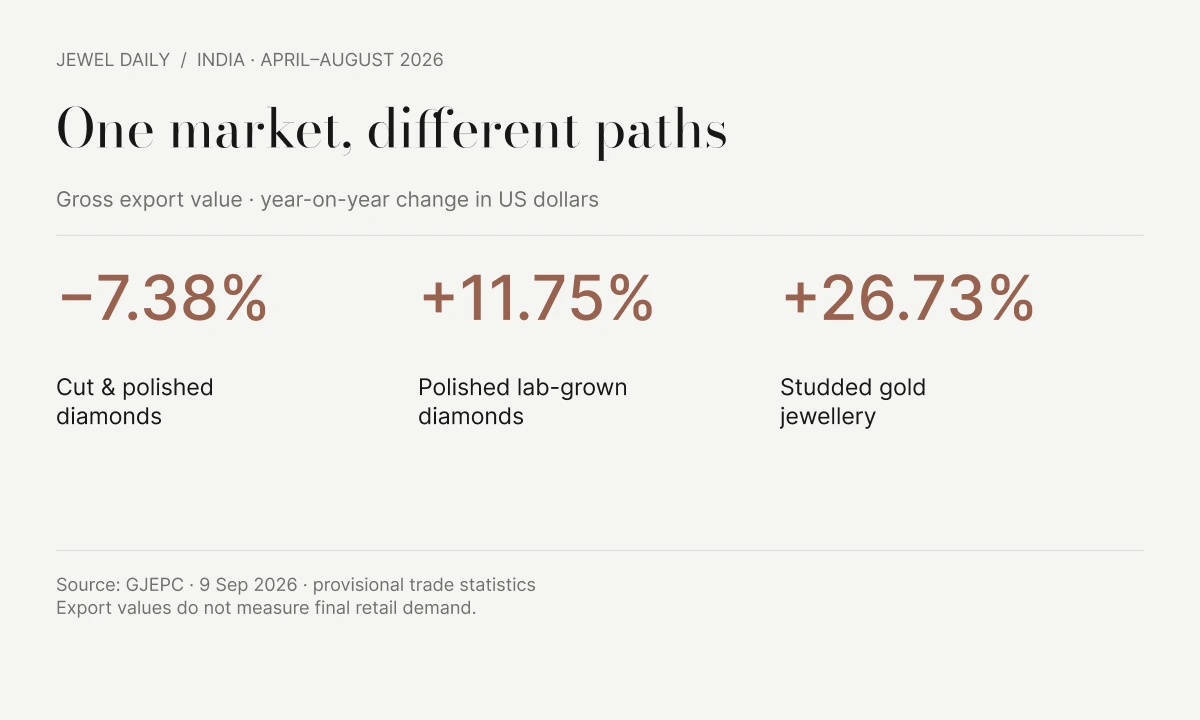
GJEPC’s provisional report, dated 9 September 2026, puts India’s April–August gross gem and jewellery exports at US$11,467.49 million, up 2.58% year on year. Cut and polished diamond exports fell 7.38% to US$4,521.12 million, while polished laboratory-grown diamonds rose 11.75% to US$533.67 million.
Studded gold jewellery exports increased 26.73% and plain gold jewellery fell 11.44%. In the diamond categories, exported carat volumes rose 6.75% for cut and polished diamonds and 23.37% for worked laboratory-grown diamonds. The council labels the trade figures provisional and subject to reconciliation with DGCI&S.
More carats can coexist with weaker export value
Value and weight need to be read together. When exported carats grow faster than export value, the implied average value per carat falls. That average also changes with size, quality, destination and product mix; it is not a price quote for an otherwise identical diamond.
The divergence between studded and plain gold jewellery is also a reason to avoid using total gold jewellery exports as a single demand signal. Nominal dollar values can reflect metal prices and changes in assortment as well as orders. This report measures cross-border trade, not final retail sell-through.
A practical way to use the trade report
Buyers can separate natural and laboratory-grown diamond orders, then compare like-for-like size and quality brackets with actual supplier quotations. For gold jewellery, track metal weight and making charges alongside invoice value. These checks are more useful for assortment planning than extrapolating the aggregate export growth rate.