Reading De Beers’ 2025 sustainability report: progress, targets and provenance
 Original data graphic by JEWEL DAILY. Source: De Beers Group. The September release reports emissions, livelihoods and Tracr milestones for 2025. This reading distinguishes company-level progress from the evidence needed for an individual diamond.JEWEL DAILY · Figma
The September release reports emissions, livelihoods and Tracr milestones for 2025. This reading distinguishes company-level progress from the evidence needed for an individual diamond.
Published in 2026, reporting on 2025
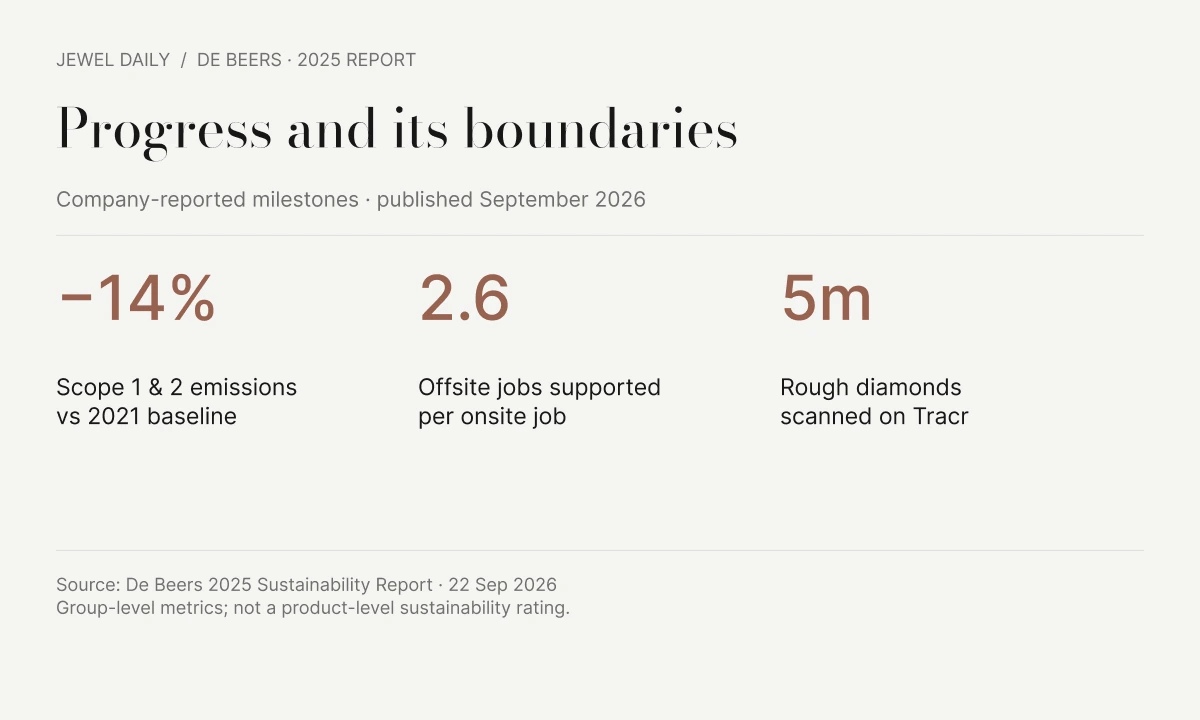
De Beers released its 2025 Sustainability Report on 22 September 2026. The company reports a 14% reduction in Scope 1 and 2 emissions from its 2021 baseline, 2.6 offsite jobs supported per onsite job, and the milestone of five million rough diamonds individually scanned on Tracr.
Its 2030 ambitions include reducing the carbon footprint by one third and supporting four offsite jobs per onsite job. The achieved figures and the targets are different statements. This article uses the company’s report and announcement; it does not independently verify every metric or assign a sustainability rating.
Do not turn a group metric into a product claim
A group-wide emissions reduction does not establish the footprint of a specific ring or diamond. A product-level claim needs its own system boundary, allocation method and evidence covering the relevant manufacturing stages. Comparing companies also requires consistent baselines and emissions scopes.
A traceability platform’s cumulative scan count describes scale, not the proportion of every retailer’s stock with complete provenance. For an individual stone, the relevant question is whether a verifiable record connects its identity and transformations through the supply chain. A platform milestone cannot replace that record.
Questions for a sourcing conversation
Ask a supplier which statements apply to the group, the facility and the actual product being purchased. Keep achieved results separate from future commitments, and request the supporting methodology before using a figure in consumer communication. That makes the report useful in due diligence without overstating what it proves.