Gemfields H1 2026 revenue recovery comes with a USD 125.2 million MRM impairment
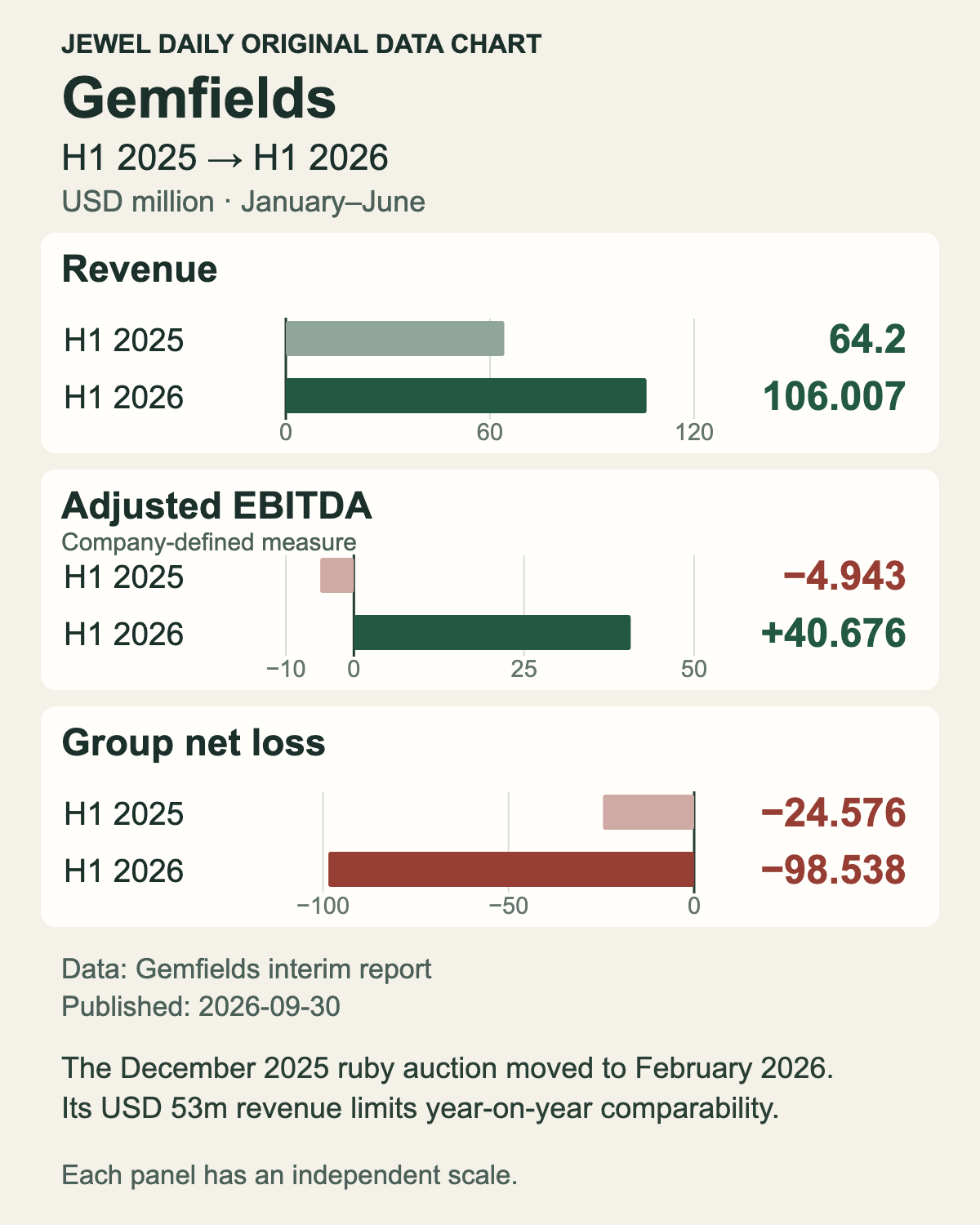 Original editorial chart by JEWEL DAILY. Data source: Gemfields Group, interim report released 30 September 2026, six-month periods ended 30 June 2025 and 2026. USD millions; negative net result denotes a loss. The shifted USD 53.0 million ruby auction affects comparability; adjusted EBITDA is not net profit.JEWEL DAILY
Gemfields reported higher revenue and positive adjusted EBITDA for January–June 2026, while its net loss widened sharply. A deferred ruby auction, weaker premium-ruby recoveries and financing uncertainty make the headline growth an incomplete guide to the business.
Revenue and earnings move in different directions
Gemfields’ interim report, released on 30 September 2026, covers 1 January–30 June. Revenue rose from USD 64.200 million a year earlier to USD 106.007 million, an increase of about 65.1%. Group net loss nevertheless widened from USD 24.576 million to USD 98.538 million.
A shifted auction changes the comparison
The revenue comparison includes a substantial calendar effect. A mixed-quality ruby auction originally scheduled for December 2025 took place in February 2026, generating USD 53.0 million. That timing limits any claim of like-for-like growth; simply subtracting the auction would not produce a fully normalised comparison either.
MRM contributed USD 76.080 million of revenue, Kagem USD 26.680 million and other activities USD 3.247 million. Auctions represented approximately 97% of the total, underscoring how individual sales and their product mix shape the reporting period.
More carats do not settle the premium-ruby question
At Montepuez Ruby Mining in Mozambique, total ruby and corundum production reached 2,164,388 carats, compared with 1,145,134 a year earlier. Reported premium-ruby production was 30,408 carats against 34,823.
However, MRM removed the Secondary Low Sapphire and Low Sapphire grades from its premium category. The premium figures therefore are not a clean like-for-like series. The operational question is how reliably expanded processing capacity can deliver valuable material, rather than whether aggregate carat output alone increases.
The impairment resets expected asset value
The group recorded a USD 125.2 million non-cash impairment at MRM, reducing the relevant cash-generating unit’s carrying value from USD 205.5 million to a recoverable amount of USD 80.3 million. Management principally linked the reassessment to lower forecast premium-ruby grades. Difficulties commissioning the second processing plant, PP2, added uncertainty; target processing rates were not consistently achieved until mid-June.
Company-adjusted EBITDA improved from negative USD 4.943 million to positive USD 40.676 million. This measure excludes specified impairments, fair-value movements, share-based payments and other provisions. It is not net profit. The impairment did not itself consume cash, but records a weaker assessment of future cash generation.
Cash collection and net debt need separate dates
Net debt stood at USD 44.237 million on 30 June, up from USD 39.289 million on 31 December 2025. A fall in gross borrowings therefore did not amount to a reduction in net debt over the half-year.
The announcement separately said USD 33.3 million of auction receivables outstanding at June-end had been collected in full by publication. Those receipts cannot be treated as June cash or used alone to calculate subsequent net debt without the intervening cash flows.
A material uncertainty remains
The financial statements retain the going-concern basis, but disclose a material uncertainty. The assessment includes a forecast December 2027 covenant breach on MRM’s USD 25 million ABSA term loan, possible loss or deterioration of overdraft facilities, and premium-ruby recoveries below forecast. Management identifies mitigating actions, including cost reductions, that could affect longer-term performance.
EY drew attention to that uncertainty without modifying its review conclusion. An interim review is narrower than an audit and provides no audit opinion. The disclosure identifies significant conditional liquidity risks; it does not establish that the group is insolvent.
What this means for reading gemstone-company results
For jewellery-industry readers, the report shows why auction timing, gemstone quality mix, asset assumptions and liquidity need to be read together. Management’s observations about demand describe its own markets and sales; one producer’s results cannot establish a sector-wide recovery. Sustained premium-ruby recoveries and cash conversion remain more informative tests of progress than revenue growth alone.
Related articles
 Jewelers Board of Trade
North American jewellery businesses: Q2 2026
Read article CIBJO
CIBJOCultured pearls: production, research and marine ecosystems
Read article World Gold Council / Metals Focus / ICE Benchmark Administration